|

Saturday, January 24, 2026

Thursday, November 20, 2025
|
Thursday, March 9, 2023
Not all apps are created equal
 |
| Choose Wisely... |
“If I already know someone, why would I use a platform to communicate with them?”
We hear this from time to time – Dealboard members browsing
the thousands of metric tons available any given day on Dealboard, and finding
seafood offered by someone they know. Their temptation is to use their usual
ways of communicating with that party – email or WhatsApp.
Why not?
Here’s why not:
Email isn’t safe
Email is a great way to communicate, but it takes a lot of
work to make it really secure for sensitive communications such as negotiating
large transactions.
And, even with the best security measures in place, things
slip by – have you heard about this recent and high profile example of phishing
in the seafood industry? https://www.farodevigo.es/economia/2023/02/28/estafar-ceo-nueva-pescanova-anunciandole-83867748.html
The CEO in the article is clearly taking it in stride, and
even having a bit of a laugh about the situation. But this is only funny until
someone falls for it, and it’s only funny until it happens to you.
What sizable seafood company hasn't been spoofed in
the past year by an email communication that isn’t really coming from who it is
supposedly from? Things worse than this happen all the time.
Tightening your email security drives up your IT costs
significantly, and doesn’t mean something won’t happen to you. And if you fall
for it, the economic damage to your company could be irreparable.
WhatsApp isn’t much better
WhatsApp is great for instant communication, but you can
never be sure if the person you’re working with is still a representative of
the company you want to deal with.
People change jobs, and when they do they often take their
WhatsApp numbers with them. Suppose they move over to a competitor of yours…
are you really ready to share your prices, inventory and other key information
with your competition?
Then what?
Even if your email or WhatsApp conversations are not
compromised, and you successfully negotiate a transaction, what follows are a
lot of manual steps you need to do to communicate the deal terms to the rest of
your team to follow up with shipping and payment. That means you are re-typing
a lot of information rather than hunting your next deal, or you and your teams
are stuck chasing down misunderstandings with the other party.
What's needed is a safe room, a zone where seafood parties
can get their work done quickly, efficiently, and with reduced risk... so that
they can move on to the next deal and expand their business.
That's why not.
Wednesday, January 18, 2023
Evaluation Guide for Seafood e-Commerce Platforms

Seafood companies are prioritizing e-commerce platforms on
their agenda for 2023. It’s an idea whose time has finally come - with so many
changes taking place in availability, pricing, shipping and risk management,
seafood companies are recognizing the need for a bigger, more flexible network
of buyers and suppliers they trust, in order to grow their business in
challenging times.
But not all platforms are created equal. Here’s a guide for seafood companies ready to test the waters of e-commerce platforms this year. Make sure you ask and understand these 6 things to know the platform you select is right for you:
- Who’s
allowed into the club? Make sure it’s a trusted community you’re joining.
Does the platform let anyone in, or do they perform background checks
first? How strong are those background checks? Does the platform suspend
companies that violate the platform’s code of conduct?
- How real are the offers? How does the platform
ensure offers are real? One of the most frustrating parts of the online
experience is pursuing an offer only for it to vanish. Don’t become a
victim of companies who are more interested in fishing for your interest
than buying or supplying you actual fish.
- Who sees your offers and negotiations? The last thing you want
is for your competitors to see your prices, or for all your customers see
that you offered a better deal to your top 5 customers. Understand whether
anything you post in the platform is visible to non-members, and ask for a
demo to see for yourself how well you can control your own information
within the platform. Remember - negotiations and final terms of the deal
should never, ever, be visible to anyone but you and the buyer or supplier
you transacted with.
- Do you know who you’re trading with? Some platforms stand in
the middle of the transaction, so you don’t know who your buyer or
supplier is. Steer clear – you need to expand your network, not diminish
it.
- Can you try it for yourself before you commit? Does the vendor require
payment up front or do they let you see the value of their platform first?
Platforms are new, and all platforms don’t work for everyone. You can only
decide if it works for you by trying it out.
- What
is the vendor like to work with? E-commerce platforms offer great advantages. But you
need to be able to trust and rely on your vendor as much as you do your
buyers and suppliers. Do you have access to key staff or are you just a
number with no influence? Do they really listen and are they helpful?
Friday, September 23, 2022
Dealboard Returns to Conxemar

What a difference a year makes -- one year ago, Dealboard attended our first trade show, Conxemar, in Vigo, Spain.
What started as an exploratory information-gathering event turned into an overwhelming number of interested prospective customers, as the Dealboard value proposition of trust, security, efficiency, and a growing network resonated strongly with both seafood buyers and sellers.
We are returning to Conxemar again this year, October 4, 5 and 6, once again in Vigo. We hope to see you there!
This year, we look forward to seeing our current customers in person, in addition to welcoming more new members into the growing Dealboard trusted community which now includes buyers and sellers spanning 26 different countries.
Want to learn more? Send us a note at info@dealboard.biz or use this form, and we would be happy to set up a meeting at Conxemar!
Thursday, July 28, 2022

Thursday, July 21, 2022
How to give yourself the gift of time

“I don’t have time.”
How often do you seek someone’s attention only to hear that phrase? How often do you use that phrase with others?
In the seafood industry, where staff layers have been cut back and where margins are razor-thin, it’s customary to be extremely busy. Some may even feel a sense of importance because they don’t have room in their schedules.
But are you keeping busy with the right things?
Recall the Eisenhower Matrix, which organizes work based on urgency and importance:
|
|
Urgent |
Not Urgent |
|
Not Important |
Are you too busy here… |
|
|
Important |
|
…to have time for what’s
here? |
Wouldn’t it be nice to receive the gift of time? To free up
your schedule to focus on more important things, and things you don’t get
around to enough in your daily activities?
Negotiating seafood transactions is pretty important, and urgent, so this usually receives a lot of attention, rightly so.
But after the transaction is negotiated, what happens next? Hiding right behind the negotiation lies a host of necessary tasks which eat up valuable time. Think about all the different teams both inside and outside your company who need to be informed of the details of the transaction – logistics services, inspection services, operations, accounting, and more.
Dealboard believes you can gain back valuable time by rethinking how you connect the place where you negotiate transactions with the rest of your business. Any time you re-type something into another system or pick up the phone to recite information to someone else, you’re consuming your own time on tasks which, though urgent, aren’t the most important. To make matters worse, if you are anything less than absolutely perfect every time you do this, you might make a simple mistake and introduce an error which costs you and others even more valuable time to correct.
Give yourself and your team the gift of time by improving and automating your operations. Negotiate transactions using a platform which can automatically and flawlessly transmit the transaction details to the systems, departments and third parties who need to spring into action to fulfill it.
You deserve the gift of time.
Friday, July 8, 2022
Food Sources Under Siege: What We Knew is No Longer True
Everything which used to be reliable and stable in
seafood has changed… so what's next?

Professor Thomas Gilovich of Cornell University wrote an engaging book some decades ago titled How We Know What Isn’t So. It’s about our human propensity to form beliefs which were never true.
That’s a bit different from what’s happening in the seafood
industry right now, where quite a bit used to be true, but isn’t
so any longer. Nearly everything traditionally reliable about the seafood
supply chain has now changed.
These aren’t misperceptions. Truths we used to rely on have
been thrown overboard.
Case in point:
What Used To Be So… |
…What
We Now Know |
|
Our labor
force would turn over, but was generally stable and returned year after year |
We face constant worker shortages in plants and in ports |
|
China’s processing
industry was an insatiable source of raw material demand |
China’s Zero-COVID policies idle processing facilities, killing
demand |
|
Fuel and
transportation costs would fluctuate but over the long term were fairly
predictable and inflation was a non-issue |
Fuel costs are almost 50% higher than a year ago, influencing
transportation and other costs of doing business |
|
Growing openness
between nations increased economic interdependency |
War drove international sanctions, closing the Russian market
to outside seafood |
Is there a war on the global seafood supply chain? Probably
not. Does it feel like there’s a war on the global seafood supply chain?
From inside the industry, facing this volatility and the invalidation of our
prior means of operating, it can absolutely seem that way.
Seafood companies need to rethink processing. We need to
seek new markets to replace the old ones which are now closed. We need new
trading partners who are open for business. We care about the location of trading
partners more than ever before because of port and transportation cost issues.
Essentially, seafood companies need a new way to do
business. And given that change seems to be the one thing which is consistent, the
new way of doing business needs to enable our businesses to become more nimble
than they are today – the best thing we can do is prepare our businesses to
withstand future volatility.
Are you ready?
Thursday, May 19, 2022
How to give all your business to your competitor

The link above is harmless, but the next email you receive might not be. In the seafood industry we do a lot of fishing, but how much do we worry about phishing?
Phishing is the practice of sending emails which look real for the express purpose of stealing private information. Phishing emails might lure the recipient into providing things like account number or passwords, or they might trick the recipient into clicking on a file attachment which unleashes malicious code.
When your business revolves around communicating or responding to offers via email, your business is at risk for phishing. Think about it....
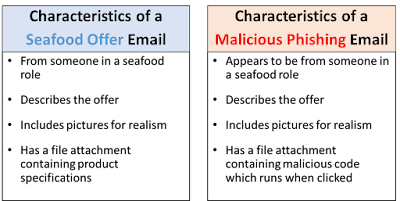
Do you feel like clicking on the file attachment in your next offer email? What if it launched a virus which stole all of your email contacts - your trading partners - and sent them to your competitor?
It pays to spot phishing. But here's the challenge -
This may not be a phishing email...


The only path to phishless fish is to manage your seafood trading in a private, safe and secure platform... and not in your emails.
Thursday, May 12, 2022
Negotiating the Deal: Technology’s Disservice to Seafood, Part 2

How do you negotiate the terms of the deal?
(price, quantity, payment terms, delivery, and more)
Dealboard’s
research indicates the overwhelming majority of the seafood industry
relies on text messaging – Skype, iMessage, WhatsApp, WeChat and more.
Here
is yet another example of technology under-serving the seafood industry,
because these methods of communication introduce problematic
situations for something as important as the terms of the deal for a large
seafood transaction between two companies.
Problem
1: Did the Chicken or the Egg Come First?
Seafood
deals require agreement on a lot of different terms and conditions, requiring exchange of many messages to arrive at an agreement.
Unfortunately, since messages cross each other, the sequence in which you see your messages may not be the same as the
sequence seen by the recipient. This means you see the discussion differently.
Consider how confusing it is to rely on text messaging for something much simpler than negotiating a seafood transaction - such as arranging to meet my son for dinner later in the week. This simple task falls down under the constraints of text messaging. To understand why, read the text exchange pictured below:

What is it that we agreed to, exactly? I have no idea whether he likes the time, the first location, or the second location I proposed.
Text messaging leaves dangerously wide room for interpretation. Do you want your trading partners to misunderstand shipping information? Payment terms? Price or quantity?
Thursday, April 21, 2022
Finding The Right Buyer or Seller: Generic Technology’s Disservice to Seafood, Part 1

How do you discover who is interested in what you have to buy or sell?
According to Dealboard’s research, if you are like 90% of seafood producers, processors and wholesalers – by far the majority of the industry – you rely on email communications and some texting to figure this out. It’s clear that technology has under-served the seafood industry, and this is yet another example. Email is an incredibly un-productive way to conduct the business of seafood transactions, for a host of reasons:
Email requires manual effort and copy/paste to construct, which takes time and introduces errors
To use email effectively for seafood offers, Dealboard often finds companies maintaining product and pricing information in Excel spreadsheets. They use this to copy-and-paste information into an email offer. But how do you know that all your buyers or sellers are working from the latest information? And, for each offer, there are always specific details that are unique to the offer and need to be filled in manually. It’s a cumbersome process in which mistakes happen. With email, you might accidentally communicate the wrong thing.
Your message easily gets lost in the noise
Seafood buyers and sellers typically receive 150 to 200 emails a day. If what you’re offering isn’t what they’re looking for at that moment, will they remember you an hour, a day, or a week later? They might. But it’s more than likely that your message will get lost and they will respond to someone else who offered them a similar product more recently than you did.
Email is unstructured, which makes it nearly impossible to find all the right opportunities
One way to find earlier emails is to search for them. But, search is problematic because email is unstructured and subject to semantic differences and input errors. Consider the following two offers, for identical product. If you were looking through the last few days of recent emails (hundreds, maybe thousands) to find offers for sole, you would want to find both of these:


They’re identical, but described differently.
Various parts of the world refer to the same fish using different names, which is understandable (orange boxes).
Luckily, we have the scientific name to use as a common means to identify a species of fish, however in one of the cases above the scientific name is misspelled (purple boxes). As Dealboard works with seafood companies around the globe, we uncover scientific name misspellings very frequently.
Even standard codes such as FAO fishing areas can be referred to in different ways (green boxes). A human being can easily identify that both offers were caught in the same fishing area, but your generic email system wouldn’t.
If you were searching your inbox for recent offers for sole, none of the normal search terms you might use would show you both of these offers. You would miss one or the other, or both of these offers. That means missed opportunities for buyers and for sellers.
Moral of the story:
A rose by any other name might smell as sweet… but you would never be able to locate it in your email inbox.
It's time for a new way to discover who is interested in what you have to buy or sell, which gets around the limitations of email.
Friday, March 25, 2022
Seafood Expos - Boston was Great; On to Barcelona

On the heels of a busy and promising Dealboard experience at Seafood Expo North America last week, we're preparing for something even bigger - the move of Seafood Expo Global from its longtime home of Brussels to the shores of the Mediterranean in Barcelona.
While we won't have a physical presence on the show floor, we wouldn't miss attending this first-ever event. We look forward to continuing there the conversations we've begun with many of you, and initiating new ones.
Since we're not anchored in one place it might be difficult to find us during the show... so we are offering to schedule meeting places and times in advance. Will you be at Barcelona? Let's meet up! Please send an email to info@dealboard.biz and we'll work something out.
Thursday, March 24, 2022
News: Dealboard and Euler Hermes announce partnership to bring confidence to wholesale seafood transactions

Integration enables seafood producers, processors,
wholesalers, exporters and brokers to manage credit insurance coverage while
negotiating transactions
Dealboard, the global
electronic seafood market, and Euler Hermes, the world's largest trade credit
insurance company, announce a partnership to bring certainty, efficiency
and ease to the process of buying and selling wholesale seafood. Trade credit
insurance provided by Euler Hermes may now be easily accessed and managed
through Dealboard’s e-commerce platform.
“Providing a fast and easy means to access
trade credit insurance gives seafood suppliers assurance that they will get
paid for goods they sell,” said Steve Engdahl, director, Dealboard. “Our
customers want a simple user experience. Our integration with Euler Hermes delivers
Dealboard customers a clean, simple and very efficient way to negotiate and
transact with confidence.”
“Euler Hermes saw the opportunity to provide an
additional level of protection and certainty to our policyholders transacting on
the Dealboard platform,” said Aaron Lindstrom, regional head of partnerships,
Euler Hermes North America. “Our integration with Dealboard eliminates extra
manual steps or the need to pivot between multiple systems in order to finalize
and insure seafood deals.”
Seafood producers, processors, wholesalers,
exporters and brokers need to assess the creditworthiness of potential buyers.
Now they may confirm or establish Euler Hermes trade credit insurance coverage
for their trading parties as they negotiate transactions within Dealboard. Dealboard
provides the tools and marketplace for finalizing transactions, insurance is
offered by Euler Hermes, and Dealboard makes use of Euler Hermes APIs to bring
credit insurance inquiries to the seller’s fingertips.
About Dealboard
Dealboard is the global electronic seafood market, a SaaS
software platform for producers, processors,
wholesalers, exporters and brokers of seafood. Dealboard brings
transparency, traceability and efficiency to global food supply chains through
communities of trust, making global electronic trading affordable, easy and
seamless. Dealboard solutions undo fragmentation, eliminate factors which
undermine trust, and level the playing field for vendors of all sizes and
regions.
For more information, please visit www.dealboard.biz
About Euler Hermes
Euler Hermes is the
global leader in trade credit insurance and a recognized specialist in the
areas of surety, collections, structured trade credit and political risk.
Headquartered in Paris, Euler Hermes is present in more than 50 countries with
5,800 employees. In 2020, Euler Hermes global business transactions represented
824 billion Euro in exposure. Euler Hermes is a full member of Allianz Group.
For more information,
please visit www.eulerhermes.us
Thursday, February 10, 2022
The Fox, The Henhouse and the Fish (Why independence matters in your e-commerce platform)

One of the reasons maintaining trusted relationships is so important to the seafood industry is the many disreputable parties who find a way into the seafood supply chain, looking for ways to game the system. Whether it’s IUU fishing, mislabeling, failure to deliver product or failure to pay, these actors work to their advantage and to the detriment of other industry participants. But the chances to be gamed don’t stop at these obvious factors.
There are so many steps in the seafood supply chain, that it’s difficult to preserve margin at each step in the process. Anything that disrupts seller-buyer dynamics is a threat. We all use our relationships and history to know who our trusted buyers and sellers are, versus others who might step in ahead or behind us in the supply chain but not add value. But are there ways a predatory party could lurk in and around your transaction process, undetected?
An important consideration here becomes the independence of your e-commerce platform. When choosing a platform and marketplace for negotiating wholesale seafood transactions, it’s critical to look beyond what the platform offers and who the trading counterparties are, to also understand who is backing the platform itself. Is the platform backed by a broker or seafood company you compete with or transact with? If so, think about the kind of information about your business that company could have access to – who you do business with, what you have available to buy or sell, the prices you’re getting, and more.
Marketplace platforms which aren’t independent are a perfect case of the fox guarding the henhouse… or in this case, guarding your fish.
For the record – Dealboard is an electronic seafood marketplace independent of any broker or competing seafood companies. We do not take a position in any transaction.
As a stand-alone company not affiliated with any broker or competing seafood company, using Dealboard is a way to preserve your business model, your proprietary information, your trusted relationships and your margin.
Thursday, January 13, 2022
When is a fish like a bond? (How unique, really, is the seafood industry… Part 2)
In our last post, we concluded that the seafood industry had enough uniqueness that buying and selling seafood is not well served by the predominant industry-agnostic platforms, which among other things, spread information more widely than needed and compound issues associated with trust and relationships.
But, exactly how unique is the seafood industry? If it is
truly one-of-a-kind, then addressing industry challenges will always be slow
and expensive, since solutions must be bespoke one-offs, and the industry has
only its own mistakes to learn from. If, on the other hand, the very
characteristics of the seafood industry which render industry-agnostic
platforms inappropriate happen to be shared by at least one other industry,
then the seafood industry can benefit from lessons learned and successes
achieved in that other industry.
We see useful similarities between wholesale seafood
transactions and transactions in the securities markets. A fish doesn’t look
like a bond, walk like a bond, or – fortunately – taste like a bond, but it
might transact like a bond. Or sometimes like a stock. Or, other times, like a derivative.
How to Avoid Getting Gamed
In the stock markets, it doesn’t pay to spread information
about your intentions to buy or sell too widely, especially if you have a large
quantity to transact. In a world where the average trade size is a couple hundred
shares, the company looking to sell a million shares has a tough job. Announcing
an intent to sell that much will influence the supply/demand balance and make
it impossible to get a good price. This applies to seafood too – rather than telling
everyone what you have, it’s important to advertise only to those you have
successfully transacted with before, and to advertise a small amount just to
identify who’s interested, then go from there.
Know your Customer
In the stock market, one doesn’t
need to know or care who is doing the buying or selling – every share is identical,
and transactions are cleared through a central counterparty so it doesn’t
matter who was on the other end of your transaction. But over-the-counter
securities, particularly derivatives, don’t work that way. Like seafood
transactions, they’re negotiated and arranged bilaterally and privately between
two parties. Here also the securities industry provides “hints” on how to handle
the situation – from rigorous customer due diligence and know-your-customer requirements,
to risk hedging, credit insurance and other protections for both buyer and
seller.
These and other techniques perfected
in the securities markets can apply to seafood buying and selling – if the
platform you’re using includes them. Generic platforms aren’t appropriate for
buying and selling seafood, but when a fish is like a stock, a bond, or a
derivative, then it pays to borrow from what’s been perfected elsewhere to benefit
the seafood industry.
Thursday, December 16, 2021
How unique, really, is the seafood industry? (Part 1)
When I’ve spoken at conference events in various locations around the world, I often receive a question about a topic which concerns the industry as a whole, but where the questioner is asking me to comment on the “uniquely X perspective” on a macro-level problem, where X is whatever city, state or country we’re in at that moment.
In many cases, there is a unique twist at a local level to
what’s going on, and I’m happy to comment about the unique challenges a broader
issue presents for a specific area.
But in other cases, macro-level issues of the world boil
down to pretty much the same issues for local participants. For example, to the
extent that the nation is dealing with inflation, and my home state of
Massachusetts is dealing with inflation, then the dynamics for northeast
Massachusetts vs. southeast Massachusetts, when it comes to inflation, aren’t
necessarily all that unique. The issues are real, but the “unique” label is
spurious.
This applies to different industries, too. At some
fundamental level, lessons learned in one industry can be expressed in generic
terms which apply directly to other industries. But at other levels, what works
for one industry can’t be guaranteed to work in another. The trick is to detect
when the “unique” label is valid and when it is spurious.
Today, let’s focus on e-commerce platforms. E-commerce serves
a wide range of different industries. A number of really strong e-commerce
platforms which are wildly successful across these different industries, for
both retail and business-to-business transactions. Take a look at how Alibaba and Amazon Business are doing, for example.
But do these platforms address the unique needs of the seafood industry? As we speak with processors and wholesalers in the seafood industry who have tried platforms such as Alibaba, it’s clear the answer is no. Industry-agnostic platforms leave both buyers and sellers of seafood down in a few ways:
1. They spread information more widely than needed
When buying or selling in bulk, it’s important not to get “gamed” by sharing too much information with too many parties. This is one reason direct messaging technologies such as Skype, email and WhatsApp are so prevalent in the seafood industry. In a world where there are actors who do not intend to transact, but stalk e-commerce platforms to gather information, sharing too much puts you at a disadvantage and can lead you to get less than the best price for your transaction.
2. They compound issues associated with trust and relationships
We’ve written previously about the importance of knowing your counterparty, of building trust, and of maintaining relationships. On many e-commerce platforms, what you post is available to any buyer – whether you know them or not. It won’t help you manage and incentivize those with whom you have the closest trusted relationships, and to the extent you don’t know your buyer, you also don’t know your risk.
We’ve heard horror stories about both issues. So – while
there’s a need for e-commerce in the seafood industry, it has enough uniqueness
to demand an e-commerce platform which has been specifically tailored to the
industry’s needs.
Check back after the holidays for a different take on this subject.